browse by category or date

Yesterday was the last day of my communication training. Unlike the first day, this time around I couldn’t be inside the class all the time. Urgent matters keep on popping up, making me left the class intermittently.

Although I was on and off with the class, I was lucky that my team helping me filling in the gaps. The topic was about conflict handling. We discussed on issues like what should we do if our team members involved in conflict? What should we do if we are actually involved in a conflict? How to handle conflict professionally?

First, when I said conflict, I mean unresolved disagreement between two person. Or, there is no disagreement, but one side hold a grudge against the other. Any conflict is advisably should be solved immediately. The longer the conflict remains unresolved, the more explosive it might become.

If we saw an open altercation between two members of our team, we need to do the following:

  1. Separate the two person. Ask who want to talk first.
  2. The other person shall wait in different room. Get another manager/supervisor within the same rank as us to talk to this other person
  3. Find out the root cause of the conflict. Was there any previous disputes between these two?
  4. Verify any facts/opinion stated by both sides
  5. Must maintain our fairness and objectivity
  6. Brainstorm together for the best win-win possible solution. If not, align the solution with Company’s goal
  7. Make sure both sides can accept the solution, make them sign in black and white if necessary

We can based on Thomas-Kilmann model when searching for the solution of a conflict:
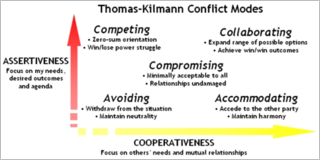
If possible, we should always start with Compromising. Then as we go along, we also brainstorm aiming to reach Collaborating.

About Hardono

Howdy! I'm Hardono. I am working as a Software Developer. I am working mostly in Windows, dealing with .NET, conversing in C#. But I know a bit of Linux, mainly because I need to keep this blog operational. I've been working in Logistics/Transport industry for more than 11 years.

Possibly relevant:

This is another interesting topic that we discussed in the first day of my communication training. We often assume that communication is more on conveying message. But let’s not forget that receiving and understanding the message is equally important.

Most people do not listen with the intent to understand; they listen with the intent to reply.
-Stephen R. Covey

We have two ears and one mouth, so we should listen more than we say.
– Zeno of Citium

Here are 10 ways to improve our listening skills:

  1. Before begin to listen, start with a deep inhale and exhale quietly.
  2. Listen and relax. Don’t even think on how to reply. Our job now is to listen and gather data.
  3. When the other party pauses, summarize our understanding then ask whether we got it right so far.
  4. Don’t multitask while listening. Or, don’t ever multitask on anything.
  5. Show empathy. We might have an contrast opinion, but can we found common ground?
  6. If we get confused, immediately raise our hand then ask question
  7. Maintain proper eye contact (if the culture permits)
  8. Always remember what is the goal of this communication. This goal should guide us along the communication to make sure we are on the right track
  9. Listen with open mind. Put aside any biases or prejudices that might affect on how we hear things.
  10. Pay attention to things which are not said. Does the body language seems to contradict what has been said? If yes, then make clarification if necessary.

I hope it’s useful.

Cheers

About Hardono

Howdy! I'm Hardono. I am working as a Software Developer. I am working mostly in Windows, dealing with .NET, conversing in C#. But I know a bit of Linux, mainly because I need to keep this blog operational. I've been working in Logistics/Transport industry for more than 11 years.

Possibly relevant:

During my yesterday’s training, we were discussing about styles of communication. From the style of communication, we will be able to deduce the likeness of a person. There are at least four styles of communications:

  1. Expresser
  2. Driver
  3. Relater
  4. Analytical

Below table will show the traits of each style, how to deal with them, etc:

A person usually has one dominant style, and one sub-dominant style (E.g. John guessed that I myself is a driver and analytical). Hopefully, by knowing the style of the person we are communicating with, it will increase the success of the communication.

It is said that if you know your enemies and know yourself, you will not be perilled in a hundred battles; if you do not know your enemies but do know yourself, you will win one and lose one; if you do not know your enemies nor yourself, you will be perilled in every single battle.

– Sun Tzu

The first that come to my mind when reading above table was “what is my wife’s communication styles?” 😀

So, can you identify what’s your own style of communication?

About Hardono

Howdy! I'm Hardono. I am working as a Software Developer. I am working mostly in Windows, dealing with .NET, conversing in C#. But I know a bit of Linux, mainly because I need to keep this blog operational. I've been working in Logistics/Transport industry for more than 11 years.

Possibly relevant: